Why Legacy ERP Systems Struggle with Modern B2B Commerce
Built for back-office stability rather than front-end agility, traditional ERPs create data bottlenecks that prevent real-time scaling. Discover why forcing a "System of Record" to act as a "System of Engagement" is stalling your growth.
The Hidden Bottleneck in B2B Revenue Growth
Right now, more than 80% of B2B buyers expect to experience a seamless digital purchasing experience that is on par with what they expect as consumers in other parts of their lives.
But behind the scenes, millions of dollars in industrial transactions are stalled—Why? Because manufacturers and distributors are trying to process today's fast-paced digital buying habits using back-office technology systems from a decade ago.
For CEOs, COOs, and IT directors of mid-market manufacturing enterprises ($20M-$500M), the ERP system is undisputedly the "brain" of the company.
It handles logistics, complex routing for inventory, and general ledgers. However, when you stretch this aging infrastructure to serve as a customer-facing digital storefront, the cracks will be immediately visible.
The Current Landscape of B2B Digital Transformation
The industrial sector has undergone a rapid architectural evolution, shifting from basic electronic filing to fully-transactional global ecosystems.
System of Record
Digital transformations were limited to merely converting paper documents into electronic versions or creating static catalog websites—built primarily for internal manual processes and office-hour stability.
System of Engagement
Buyers in the US, UK, and UAE expect asynchronous efficiency. A procurement officer uploading a CSV at 2:00 AM requires instant contract pricing, warehouse verification, and complex routing logic.
The fundamental friction in today's manufacturing space lies in forcing a System of Record to perform like a System of Engagement. Understanding this distinction is the first step toward a successful B2B implementation.
Core Problem Breakdown: 6 Reasons Legacy ERPs Fail as Commerce Engines
Forcing a modern B2B portal onto a highly customized legacy ERP creates deep-seated technical barriers that stall revenue growth.
Batch Processing vs. Real-Time API Demands
Modern B2B commerce requires real-time data exchange. When a user clicks "checkout," the system must instantly query inventory and verify credit. Legacy ERPs are designed around batch processing—updating once an hour or overnight. This architecture cannot support thousands of concurrent, real-time API calls, leading to application timeouts and operational failures.
The Product Information Management (PIM) Gap
ERPs excel at core SKU data but fail at rich media like 360-degree videos, CAD files, and high-res imagery. Forcing a media database into the ERP environment bloats the system, severely detracting from its primary financial and logistical performance.
Architectural Rigidity and "Spaghetti Code"
Legacy systems are monolithic. Modifying the interface requires deep backend coding within a complex matrix of brittle workarounds. This "spaghetti code" prevents Marketing from making agile updates to promotions or new product lines.
Subpar User Experience and Interface Limitations
ERP-native modules offer virtually no flexibility for dynamic customer journeys. The result is a storefront that feels like a database query tool. If the UX is frustrating, buyers will abandon the portal for a competitor with a frictionless, modern interface.
Omnichannel and Multi-Region Limitations
Modern strategies require selling through D2C, mobile apps, and regional storefronts (e.g., UAE Tax Logic vs. UK VAT). Legacy ERPs lack a Decoupled Presentation Layer, forcing IT to build redundant and costly integrations for every new market expansion.
Severe Security and Compliance Vulnerabilities
Bolting a web module onto an on-site ERP exposes it to the public internet, creating tremendous cybersecurity vulnerabilities. Older systems lack modern encryption; a breach could give malicious users immediate access to sensitive corporate financials and proprietary data.
The Business Impact:
Growth Paralysis
When legacy systems reach their breaking point, the resulting "Growth Paralysis" radiates through every department of the enterprise.
Operational Gridlock
Highly paid IT resources spend entire weeks "patching" defective integrations and supporting outdated coding, leaving zero bandwidth for strategic innovation.
Revenue Leakage
Slow site speeds, inaccurate inventory displays, and poor UX lead directly to customer frustration and terminal cart abandonment during the buying journey.
Scalability Paralysis
The business becomes unable to rapidly develop new brands, onboard huge numbers of distributors, or expand into international markets due to a fragile architecture.
The Educational Framework: Decoupling the Stack
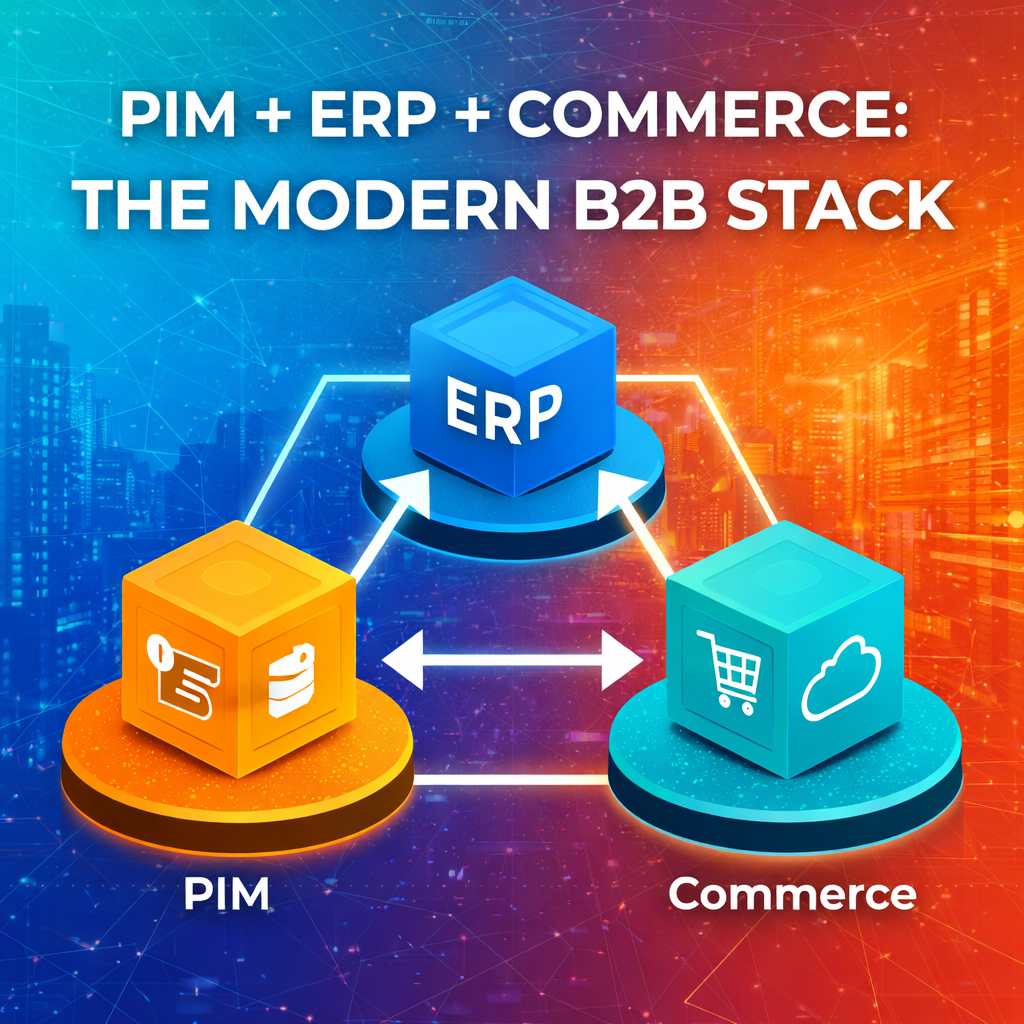
To resolve scaling bottlenecks, B2B leaders are adopting Composable Architecture—separating technology into distinct layers based on their optimal function.
System of Record
Your ERP: Stays secured behind the firewall, handling the heavy lifting of business logic, fulfillment, and finance without the strain of public web traffic.
System of Information
A PIM: A dedicated layer for centralizing, enriching, and syndicating all complex product data, rich media, and technical documentation.
System of Engagement
The Commerce Platform: The lightweight, highly agile customer-facing layer built for speed, exceptional UX, and omnichannel performance.
Modern Commerce Architecture
You don’t have to “rip and replace” your key ERP system to achieve digital excellence.
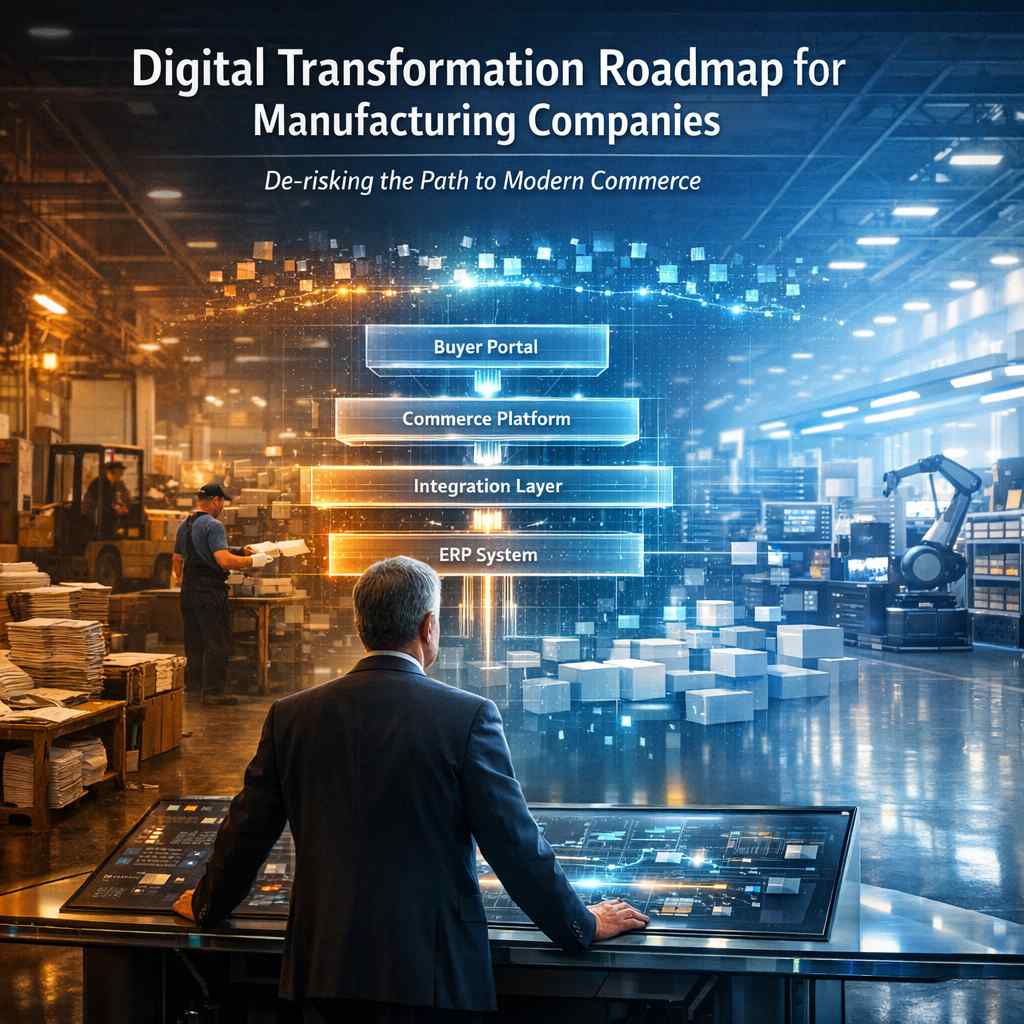
Most successful B2B transformations leverage decoupling or headless commerce via platforms like Magento / Adobe Commerce. Positioned in front of the ERP, the commerce platform handles heavy web traffic and rich user journeys while communicating asynchronously via a secure, lightweight API layer.
Bridge the Gap Between Old Logic and New Interfaces
- Protect legacy systems from traffic overloads.
- Secure backend data with API middleware.
- Build buyer experiences without IT bottlenecks.
- Enable agile marketing and sales updates.
In the meantime, for any B2B eCommerce requirements, feel free to connect with us:
Explore our B2B eCommerce Solutions.

Rajeesh E R, COO of Ceymox, is an operations-driven leader with a strong focus on execution excellence, scalable delivery models, and operational innovation within the digital commerce ecosystem. As a core member of Ceymox’s leadership team, Rajeesh ensures that strategy seamlessly translates into action—driving efficiency, consistency, and sustainable growth across the organization.With extensive experience in managing operations for IT and eCommerce service enterprises, Rajeesh plays a pivotal role in building streamlined workflows, optimizing cross-functional collaboration, and establishing predictable, high-performance delivery frameworks. His leadership emphasizes process maturity, quality assurance, and continuous improvement, enabling Ceymox to scale confidently while maintaining service excellence.Beyond operational metrics, Rajeesh is deeply committed to strengthening internal systems, empowering teams, and aligning execution with long-term business objectives. His hands-on, results-oriented approach continues to shape Ceymox’s ability to deliver value to global clients while expanding its footprint in the Magento and digital commerce landscape.
View All Articles