Why ERP Alone Cannot Power B2B Commerce: The Growth Bottleneck
Relying on back-office systems to drive front-end experiences creates a systematic erosion of profitability caused by manual friction and technical debt.
The $100 Million
Expectation Gap
Over 80 percent of B2B corporate buyers today expect a seamless buying experience similar to what consumers can find at the best ecommerce retail websites. But many mid-market manufacturing and distribution companies struggle with the idea of creating that type of experience for their customers. They want to use a single system, so they are using the most expensive systems they have, which is typically their enterprise resource planning (ERP) systems, to build bolt-on e-commerce portals to give them an all-in-one digital selling platform.
It makes sense in theory, you would think that running your store out of the same software where you manage your inventory and send invoices would be ideal.
Strategic Warning
However, putting a back office financial system into play as a front office customer experience system is going to create huge bottlenecks. The end result of using only ERP-based solutions for B2B commerce will limit the ability of $20M- $500M sized businesses to grow revenue through new channels, alienate channel partners, and lead to significant technical debt.
The Current B2B Digital
Transformation Landscape
Over the past ten years, there have been substantial changes in how manufacturing companies design the architecture of their digital commerce. In the United States, the UK, and the UAE, monolithic enterprise resource planning (ERP) systems were previously considered to be the central part of an organization's IT infrastructure. These ERP systems contain all company information, such as financial ledgers, product specifications, and product images.
In today's digital environment, speed and agility are becoming increasingly important. Buyers expect instant search results, high-resolution images, 3D product models, personalized dashboards, and mobile-friendly purchasing paths. Additionally, buyers would like to view their shopping history, track orders, or access their order status through a dashboard that they can customize.
Organizations that use a best-of-breed approach in designing their digital commerce architecture will continue to be agile and able to provide seamless services to their customers. Conversely, organizations that insist on using their legacy ERPs to provide services that meet consumer needs will likely lose market share due to the frustration associated with navigating their digital buying experience.
The Core Problem Breakdown:
6 Ways the ERP Bottlenecks Commerce
The "Database" User Experience (UX)
Technical Debt Tax:
ERPs have been built with data quality and back-office productivity in mind, not with a focus on frontend aesthetics or user journey. Most portals driven by an ERP system look and act very much like accounting software. There is generally no intuitive way of navigating, there is no robust site search feature, and it is difficult to promote other products. If your buyers require a manual to learn how to reorder parts, they will eventually take their business elsewhere.
Inability to Handle Rich Product Information
Technical Debt Tax:
A modern B2B catalog needs vast amounts of unstructured data: high-resolution photos, video tutorials, CAD drawings, and SDS. The ERP database is designed for short alphanumeric strings (SKUs, weights, prices). The ERP will ultimately become bloated and be crippled by poor performance if it is forced to store and provide access to multimedia-rich content.
Severe Performance and API Bottlenecks
Technical Debt Tax:
ERP systems aren't built for handling thousands of simultaneous web queries. Since many sites use the same codebase for both, each customer interaction creates a synchronous request to the ERP. During busy periods, this traffic can make pages take forever to load or, in extreme cases, completely shut down internal financial processes.
Non-Existent SEO and Marketing Capabilities
Technical Debt Tax:
To attract organic traffic, a system must allow marketing teams to create landing pages quickly and manage URL structures. Most ERP portals are rigid, requiring developers for simple tasks. In addition, much of the site is typically hidden behind a login screen, making products unavailable to Google and new potential customers.
Lack of Agile Personalization
Technical Debt Tax:
B2B buying is personalized to each distributor, with unique catalogs and approval workflows. While the ERP knows pricing logic, it lacks the frontend flexibility to dynamically change the user experience—such as custom homepage banners or promotional packages based on geographic location or history.
The "Hostage Upgrade Cycle"
Technical Debt Tax:
When your storefront is a module within your ERP system, your digital agility is tied to ERP upgrade cycles. Implementing a new payment gateway, for instance, requires a major, expensive, and risky global ERP upgrade just to integrate it into your commerce application.
The Business Impact:
Margin Erosion and Stalled Growth
The limitations of using ERP-powered commerce go far beyond the IT level. They create system-wide risk across the enterprise:
Operational Risk
IT teams spend most of their time writing custom code to fix synchronization errors just to keep a rigid portal functioning. Employees with significant salaries and talent have to divert their skills and energy from developing business strategies to endless maintenance.
Revenue Risk
Complex, slow-loading e-commerce sites can result in excessive cart abandonment rates. Without search engine optimization (SEO), businesses rely almost completely on existing customers; therefore, they are capped in terms of acquiring new customers.
Scalability Risk
When manufacturers acquire additional or new brands or want to establish a D2C platform, an ERP-based approach cannot scale to support a multi-tenancy architecture. Each time a manufacturer expands, it must be built from the ground up.
Rethinking the Architecture:
The “System of Record” Model
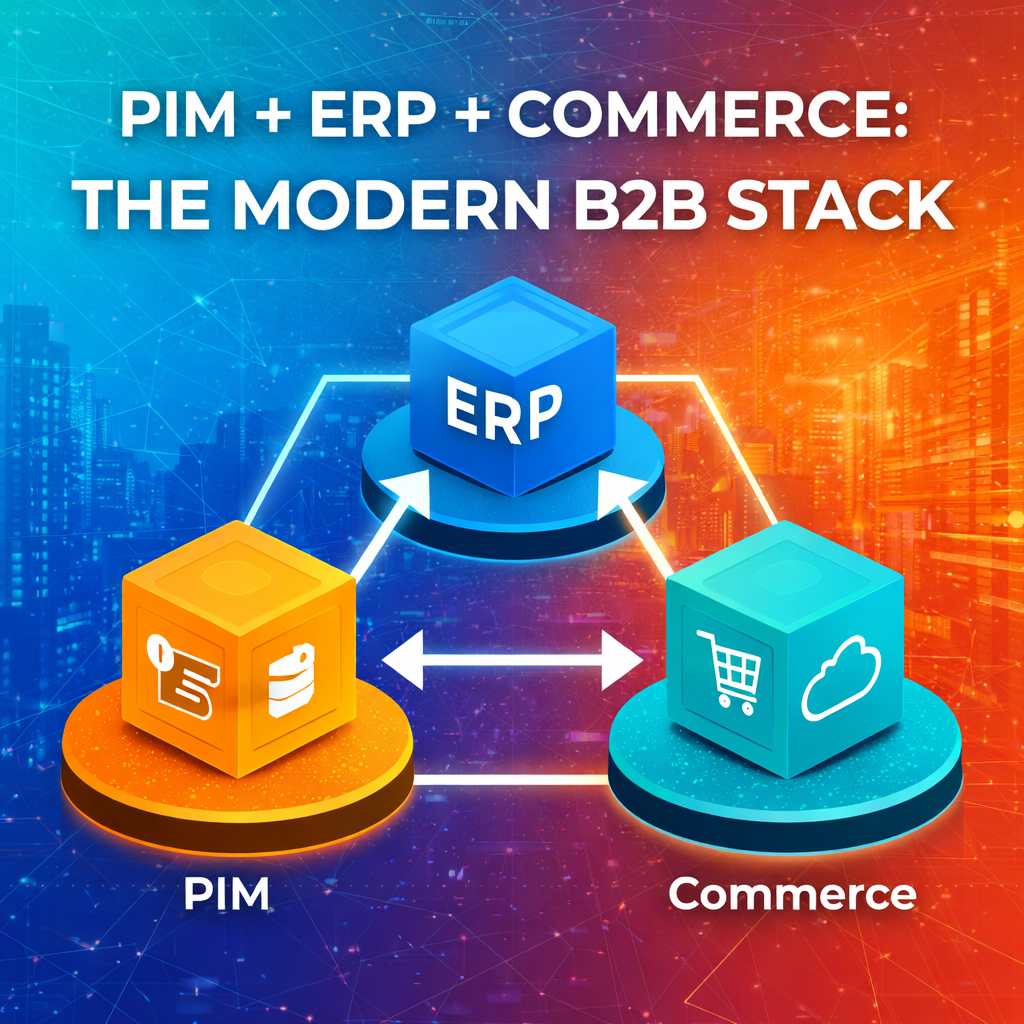
To understand this bottleneck, leaders in both IT and operational areas need to embrace the "System of Record" paradigm. Each piece of software must perform exactly the role it was engineered to do.
The "Brain"
(The ERP)
Owns the general ledger, inventory counts, base pricing, customer-specific pricing, and order fulfillment. This represents the core engine of your operation.
The "Library"
(The PIM)
Owns rich media, technical specifications, and marketing copy. The PIM serves as the definitive source for all product-related storytelling and technical accuracy.
The "Digital Storefront"
(Commerce Platform)
Owns the user experience, site search, personalized merchandising, and the shopping cart. This layer acts as the primary interface for customer interaction.
By separating the Systems of Engagement from the Systems of Record, enterprises can achieve true digital agility.
Architectural Deep-Dive:
Visualizing the ERP Bottleneck
The ERP-Only Monolith
A heavy ERP server forced into web-service roles. When CAD files, high search volumes, and SEO traffic hit the financial core, the whole enterprise slows down.
The Decoupled Ecosystem
A clean architecture where a commerce engine (Magento) shields the ERP core, caching data and handling the heavy lifting of the customer journey.
Where This Leads: Moving to Composable Commerce
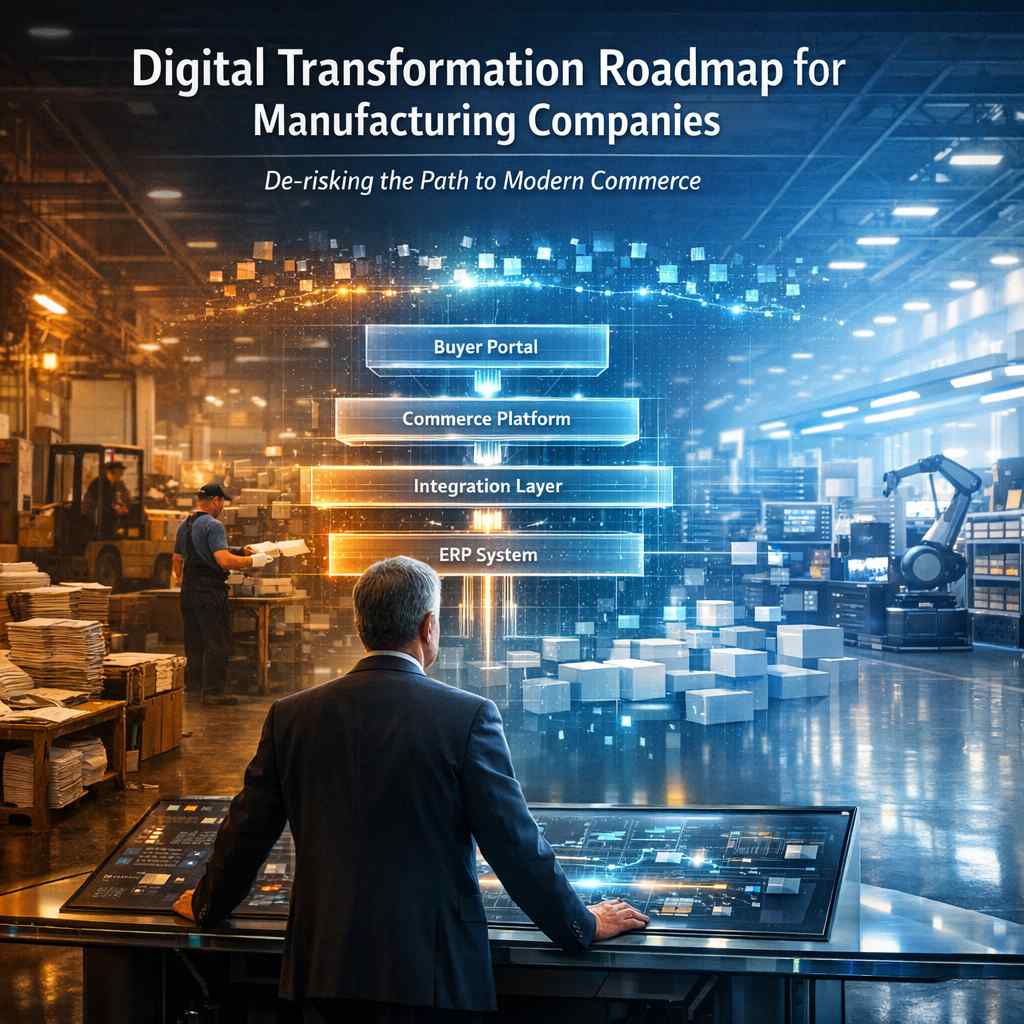
Abandoning your ERP portal does not have to mean abandoning your ERP. A modern digital strategy can make your ERP more valuable than ever by removing extraneous website traffic that causes problems.
To achieve this, you need to adopt an enterprise-grade, decoupled, API-first architecture. This involves implementing a B2B commerce platform (Adobe Commerce/Magento) that integrates seamlessly with your current ERP.
The commerce platform handles the user experience while communicating with your ERP only through secure APIs when necessary.
Next Step


Santhosh P is the Chief Technology Officer (CTO) of Ceymox, bringing over 15 years of experience in e-commerce development and more than 13 years of expertise in Magento. He has completed numerous projects for clients across various industries and regions.He has extensive experience in Magento PWA (Progressive Web Apps), VueStoreFront, and Scandi PWA, delivering fast, responsive, and user-friendly experiences for online shoppers. His proficiencies include:Hyvä Magento speed optimization Magento 2 migration and upgrade Magento extension development Magento mobile development Adobe Commerce development Third-party integration with Magento Magento core functionality enhancement Magento multi-store and multi-website development Magento SEO customization Magento marketplace integration Magento ERP/CRM integration Magento mobile integration (Android, iOS)Santhosh holds multiple Adobe certifications, including Adobe Certified Expert - Adobe Commerce Developer, Adobe Certified Professional - Adobe Commerce Developer, and Magento 1 Certified Developer Plus.
View All Articles