PIM + ERP + Commerce:
The Modern B2B Stack
Bridging the gap between industrial-strength back-office integrity and high-performance digital storefronts. Master the architecture that scales your business operations.
Strategic Synergy in B2B Digitalization
Many manufacturers incorrectly view ERPs as the “all-in-one” solution for growth. However, with over 60% of B2B buyers abandoning purchases due to inconsistent product data, it's clear your ERP is the brain—not the customer-facing experience.
In the US, UK, and UAE, CEOs of companies with $20M–$500M revenue no longer view a modern stack as a luxury; it is now a requirement for market survival.
PIM
The Heart: Enriched data, marketing assets, and translations.
ERP
The Brain: Back-office logic, inventory, and fulfillment.
Commerce
The Face: Conversion-optimized high-velocity UX.
Industry Context:
The Death of the Monolith
The B2B digital transformation environment is evolving from centralized to specialized. Historically, attempting to make ERP systems handle marketing and storefronts created unstable and disconnected user experiences.
ERP (The Foundation)
Handles back-office logic—Inventory, Fulfillment, and Credit Limits. It remains the secure source of truth for your business operations.
PIM (The Heart)
A specialized hub for marketing copy, image hosting, and digital assets. This ensures content consistency across all digital channels.
Commerce (The Face)
The platform optimized for conversion. Allows for faster page-loads and significantly improved performance across the customer journey.
6 Core Problems Solved
by the Modern Stack
The "Rich Media" Bottleneck
ERPs are developed for alphanumeric data—SKUs, weight, and cost. ERPs do not perform well when it comes to “rich media,” which is what today’s consumers expect from an online shopping experience—high-resolution galleries, 360-degree view options, safety data sheets (SDS), and instructional videos. A PIM fills this gap because it serves as a dedicated library for all marketing and technical assets.
Data Fragmentation and Silos
Without a PIM, product data typically resides in "shadow IT" or in spreadsheets located on a marketing manager’s laptop, PDF files in the engineering department, and price lists in a sales manager’s email inbox. By using the stack PIM + ERP + Commerce, we can create a "single source of truth" so that each channel displays the same information and it is always correct.
Inconsistent Multi-Channel Syndication
Manufacturers are selling products through many different channels, such as their own portals, Amazon Business, and third-party distributors. It is impossible for manufacturers to manually update all of these channels at scale. With a modern stack (PIM + ERP + Commerce), manufacturers can enter a product once in the PIM and then automatically send updates to the commerce engine and all other external marketplace channels.
Complex Pricing and Contract Logic
B2B transactions involve tiered pricing, volume discounts, and customer-specific contracts. It would be a significant risk to place complex pricing and contract logic on a website as part of your web storefront. On the other hand, if this logic exists only in your ERP, then when the web store needs to determine what price to display, it must query the ERP, which can take time. However, with the commerce platform able to “query” the ERP in real time for pricing and pull product descriptions from the Product Information Management System (PIM) at the same time, this eliminates many potential security risks.
Slow "Time-to-Market" for New Products
Engineering may be ready with specifications for new products long before marketing has finished creating a copy. This means that there is no way for the product to go live until the ERP is updated. With a modern commerce stack, however, the SKU can be created in the ERP while Marketing continues to enrich the data in the PIM. This cuts down on time to market for new products by potentially as much as 50%.
Global Scalability
If a manufacturer decides to expand their business into either the UAE or the UK, they will need to translate hundreds of thousands of technical SKUs. A PIM is developed specifically to manage multi-language localized translations and region-specific attributes, while the commerce platform handles currency conversion and tax compliance.
The Business Impact:
Growth vs. Gridlock
Operational Risk
Without a PIM, teams lose thousands of dollars in manual man-hours copy-pasting data across disconnected systems, leading to high internal friction.
Revenue Risk
Poor product information leads to high "Returns to Vendor" (RTV). Customers receive items that differ from their digital expectations, directly eroding your margins.
Scalability Risk
Relying solely on a legacy ERP "locks up" your data, making it nearly impossible to expand into new digital marketplaces or launch localized storefronts at scale.
The Golden Triangle Framework
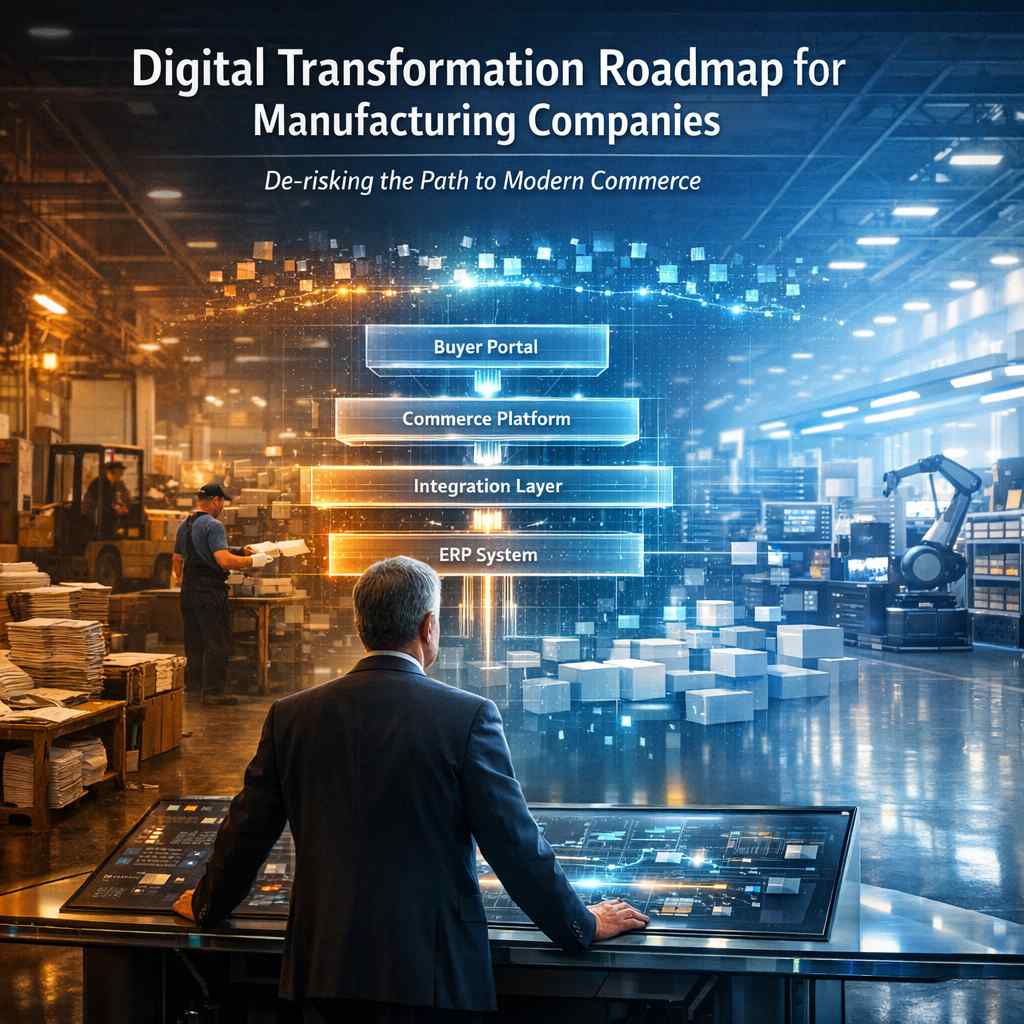
To visualize the modern stack architecture, we utilize a specialized framework that ensures operational integrity while driving digital performance.
ERP
Handles back-office logic—Inventory, Fulfillment, General Ledger, and Credit Limits. It is the core source of truth.
PIM
Handles the "Digital Twin" of the product—Descriptions, Technical Specs, Marketing Images, and Global Translations.
Commerce
Handles the User Journey—Dynamic Search, Frictionless Cart, Quote-to-Order workflows, and high-performance Mobile UX.
Path To Modern Stack:
Strategic Decoupling
Modern B2B commerce does not require replacing your legacy ERP. Success is found by decoupling the high-velocity shopping experience from rigid back-office operations.
Modular Synergy
By utilizing specialized engines like Adobe Commerce and a dedicated PIM, you deliver a seamless frontend while your ERP continues to power core logistics.
Real-Time Connectivity
The secret is data orchestration—ensuring accurate pricing and inventory sync without taxing your legacy system's core performance or security.
Deep dive into technical pathways:
ERP Integration: The Complete B2B Guide →
(coming soon)



Santhosh P is the Chief Technology Officer (CTO) of Ceymox, bringing over 15 years of experience in e-commerce development and more than 13 years of expertise in Magento. He has completed numerous projects for clients across various industries and regions.He has extensive experience in Magento PWA (Progressive Web Apps), VueStoreFront, and Scandi PWA, delivering fast, responsive, and user-friendly experiences for online shoppers. His proficiencies include:Hyvä Magento speed optimization Magento 2 migration and upgrade Magento extension development Magento mobile development Adobe Commerce development Third-party integration with Magento Magento core functionality enhancement Magento multi-store and multi-website development Magento SEO customization Magento marketplace integration Magento ERP/CRM integration Magento mobile integration (Android, iOS)Santhosh holds multiple Adobe certifications, including Adobe Certified Expert - Adobe Commerce Developer, Adobe Certified Professional - Adobe Commerce Developer, and Magento 1 Certified Developer Plus.
View All Articles