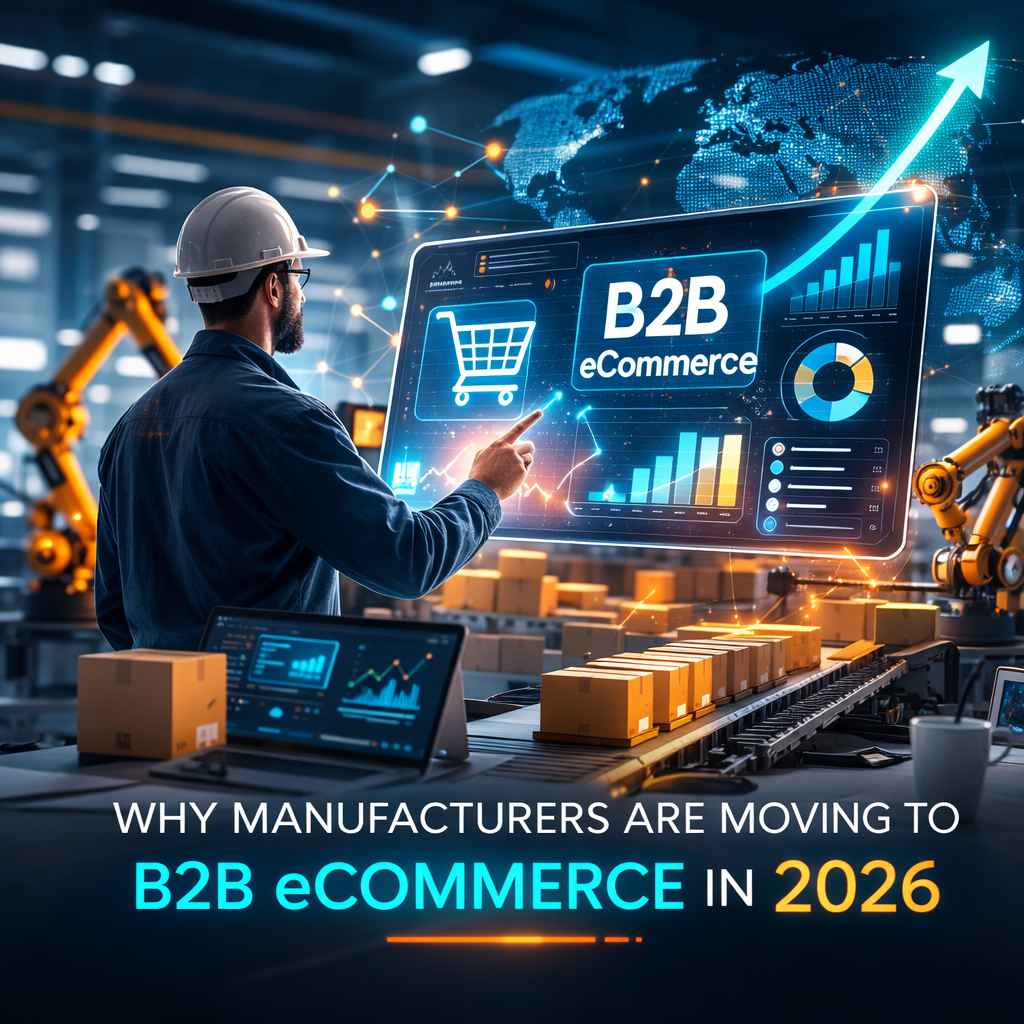
Why Manufacturers Are Losing Orders Without B2B eCommerce
Manufacturers relying on manual order processing, emails, and phone calls are struggling to keep up with modern buyer expectations. Digital procurement and real-time ordering have become essential to stay competitive.
The "Invisible" Competitor Stealing Your Market Share
When a B2B buyer contacts your sales team, the buyer has gone 70% of the distance in the purchase journey. In today's world, if your technical specs, real-time inventory, and contracted pricing are not available on the web, then you're not behind—you're invisible.
Nearly 80% of B2B buyers currently prefer digital self-serve options instead of human interaction when researching products or making routine re-orders.
As such, for CEOs and CROs of manufacturers, having a B2B eCommerce channel is no longer an "IT Gap" issue; it is a significant source of revenue leakage. While your sales teams sleep or complete manual data entry, your competitors win orders via frictionless, 24/7 digital portals.
The Landscape: From "High-Touch" to "High-Tech"
The "High-Touch" model has long been the standard for both manufacturing and distribution industries—trade shows, face-to-face meetings, and thick paper catalogs. But as an evolving generation of procurement managers, along with the world-wide shift to digital-first logistics, the way procurement is being done will never be the same.
High-Touch Procurement
Traditional procurement relied on in-person meetings, printed catalogs, and lengthy communication cycles. Orders were often processed manually, requiring significant time and human involvement.
High-Tech Procurement
Modern procurement managers now expect digital ordering systems, automated purchasing workflows, and real-time product availability that allow them to manage complex bulk orders across multiple regions instantly.
Today’s procurement managers in the US, UK, and UAE are now expecting the “Amazon-like convenience” they have experienced in their daily lives to also apply to their work. They want a “System of Engagement” that allows them to effectively and efficiently order large quantities of products across multiple time zones without waiting for a return phone call.
6 Reasons Manufacturers Are Losing Orders to Digital-First Competitors
1. The Research Phase "Wall"
Modern buyers research anonymously. If your product data is locked behind a "Request a Quote" form, the buyer will probably go to a competitor that provides CAD files, compliance certifications and transparent specification sheets on their website upfront.
2. Friction in Routine Replenishment
Most manufacturers have the highest-margin revenue from recurring orders. If distributors must email a purchase order and wait for manual confirmation every time they need to restock, eventually they will migrate over to a supplier who offers "one-click" ordering through a dedicated portal.
3. Inaccurate Inventory and Pricing Transparency
A supply chain that's constantly changing can be a disaster if you don't have a way to get an accurate "Call for Availability". The lack of integration between your e-commerce platform and ERP system means you can't provide buyers with current real-time stock levels nor offer them prices based on their specific contracts. Buyers are going to go with the surety of a digital stock count versus the uncertainty of an analog phone call to find out if there's enough product available.
4. The Slow "Quote-to-Order" Cycle
Manual quoting is slow. While your sales desk is working on determining freight and volume discount costs, your automated digital first competitor is automatically providing a quote through their commerce engine to the buyer, closing the sale in minutes instead of days.
5. Lack of 24/7 Global Accessibility
Your 9:00 AM to 5:00 PM EST order desk hours mean you're essentially unavailable to the UAE and global marketplaces during half of that time frame. Digital Commerce eliminates the "Time Zone Tax", so your company can receive revenue during hours your local office is closed.
6. Poor Mobile Accessibility for Field Technicians
The majority of B2B Buyers are working in the field, on site at job locations, or on the floor of their factories. If you have not optimized your ordering process to be mobile friendly, you will lose the point-of-need purchase to one of your competitors with a Mobile Responsive Distributor Portal.
The Business Impact: Beyond Lost Sales
The cost of lacking a digital channel extends deep into your operational efficiency:
Operational Bloat
You have to hire more customer service representatives simply because of all the manual data entry work to handle instead of using the automation to scale your business's revenue.
Customer Churn
Relationship-based loyalty is eroding; it is being replaced by "convenience loyalty."
Data Blindness
Without an online or digital channel, the business loses access to the most critical analytics about its customer base that it could use to determine what products or services the customer is looking for but unable to find, thus losing a major source of identifying future product or service opportunities.
Educational Framework: The B2B Digital Maturity Curve
To understand where your organization stands, we use the Digital Maturity Curve:
Stage 1: The Digital Brochure
Static site, no pricing, no transactions.
Stage 2: The Portal Hybrid
Customers can see some data but must still email orders.
Stage 3: Connected Commerce
Full ERP integration, real-time pricing, self-service reordering.
Stage 4: Ecosystem Leadership
Headless commerce architecture, personalized AI-driven recommendations, and omnichannel presence.
The Mini-Solution: A Strategic Shift
You don’t need to completely rebuild your company from scratch to defend your market share. All you have to do is begin the transition to Modern Commerce Architecture. A platform such as Magento / Adobe Commerce with a Headless architecture will allow you to create an E-commerce site which interfaces directly with your Enterprise Resource Planning (ERP) system. This will enable you to automate the “routine” transactional processes — those reorders, status checks, etc., — freeing up your sales team to pursue larger, more strategic enterprise clients.
Your path forward is not simply going to be creating a website but rather, it's about developing a roadmap for the evolution of your business.
Modern Commerce Architecture
A headless commerce platform integrated with your ERP enables automated ordering, real-time pricing visibility, and scalable distributor portals. By digitizing routine transactions, manufacturers can shift their sales focus toward strategic enterprise growth.
Digital Transformation Roadmap for Manufacturing Companies →
 Google Analytics Certified |
|
|
KC Jagadeep, CEO of Ceymox, a leading Magento Development Agency based in India. KC is a passionate entrepreneur, Magento enthusiast, and advocate for open-source solutions, dedicated to enhancing the landscape of online commerce, particularly within the realm of Magento.Driven by the pursuit of creating and executing successful strategies and platforms for digital commerce, KC brings over 12 years of industry experience to the table. His mission is simple: to empower corporate eCommerce clients with effective digital commerce solutions and modern marketing practices, ultimately boosting profitability.As an entrepreneur with a proven track record in information technology and eCommerce services (including Magento and WooCommerce), KC possesses expertise in operations management, startups, various eCommerce platforms, and business process outsourcing.
View All Articles