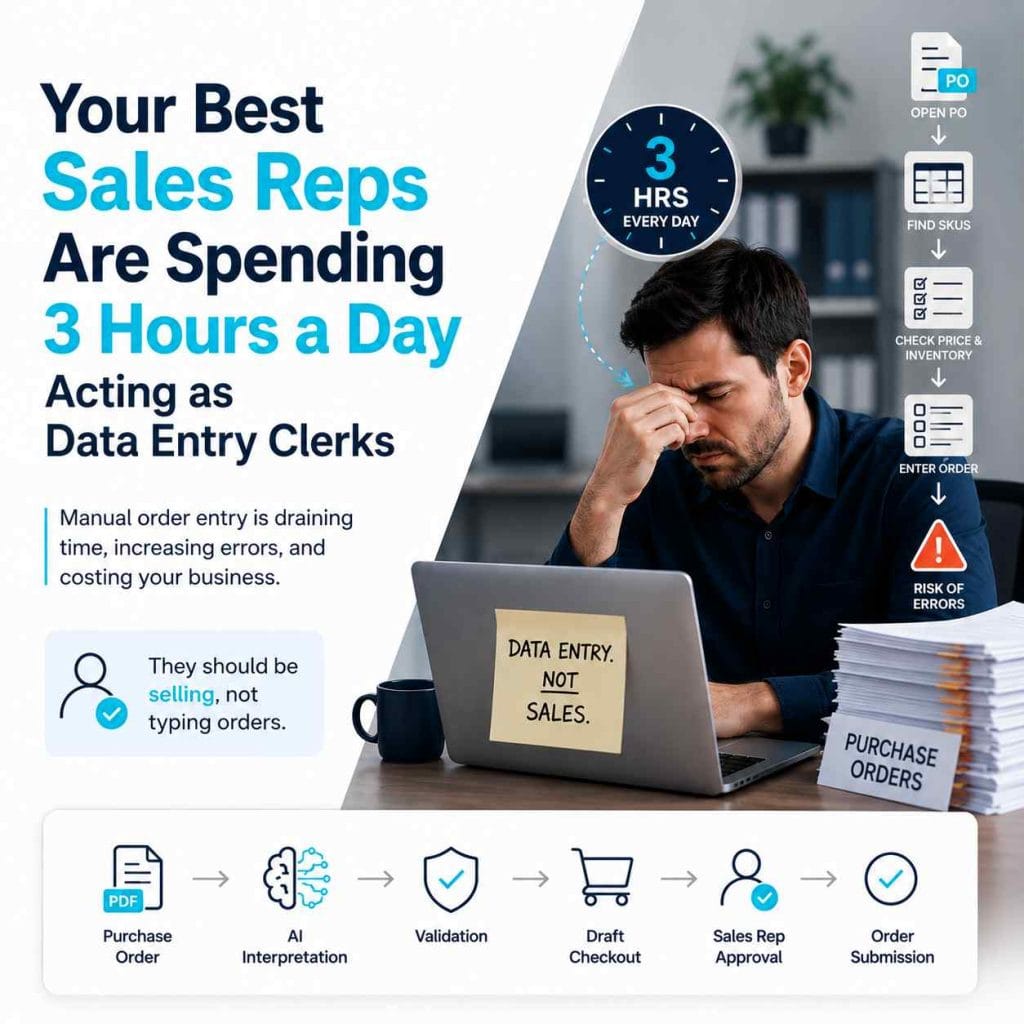
Sales leaders are obsessed with the “new lead” side of the funnel. Many of us spend a lot of time tracking leads, conversion rates and meeting our quarterly targets. However, as outlined in the report “The Silent Killer in Your Order Book,” the biggest threat to your revenue target isn’t the number of new leads; it is the quiet loss of your customer base through avoidable errors.
To a CEO or head of sales, the manual order entry process is not simply an operational bottleneck; it is a CLTV killer.
Below, we will explain why your manual order process is limiting your growth, and how digital accuracy creates “sticky,” loyal long-term partners out of your current reliable buyers.
“Fat Finger” Costs More Than You Think
Typically, when a buyer places an incorrect item in their order (a common example: a CSR misreads a “B” as an “8”), we consider it a minor administrative inconvenience. The CSR fixes it. From the buyer’s point of view however, this is not a data entry mistake; this is a reliability failure.
Studies show that approximately 80 percent of order processing errors are directly caused by manual entry of the order information. Each time this occurs, a “Rectification Cycle” begins. The buyer must contact your service department, schedule a return of the wrong product, and then wait for the correct product to be shipped.
In the B2B space where the key priority of buyers is efficiency, each friction point causes a loss of trust. As trust decreases, loyalty also decreases. While you may lose the cost of returning the product ($75+), you risk losing the entire account.
The "Sticky" Buyer: Creating Barriers to Leaving
The best strategy to keep customers is to create barriers to them leaving your company. In a manual world, finding a different supplier is simple. All a buyer needs to do is dial a phone number and speak to a CSR. It is the same amount of work to call a competitor.
Creating “sticky” customers is made possible with digital platforms. With a digital platform, a buyer receives access to a dedicated portal populated with their agreed-upon prices, specific “Reorder Lists”, and a record of their previous orders. This effectively integrates your business into theirs.
- The buyer does not see a generic catalog; they see their store.
- The buyer does not need to search for part numbers; he clicks “Reorder.”
As we discussed in the full report, this seamless shopping experience makes a buyer’s decision to switch to a competing supplier a “high friction decision”. As such, they will not leave to save a few dollars if they lose the convenience of the portal you created.
Proof of Concept: Apex Building Supplies' Transformation
This is not hypothetical. For example, Apex Building Supplies, a regional distributor with flat-line growth and a high cost-to-serve, shifted its focus to increasing CLTV B2B through digital transformation, and had success beyond what “manual hustle” could achieve. Specifically, within 18 months after launching their portal, Apex achieved:
- Error Reduction: They reduced order processing errors by 35%, and therefore provided a better buying experience for their customers.
- Revenue Growth: Their average order value (AOV) increased by 18%. This was due to the fact that the digital platform could recommend additional related items (“Shop the Look”) that would otherwise be too labor-intensive for a CSR to communicate via telephone.
- Adoption: 60% of all reorders were placed using the digital portal, allowing their sales staff to find new customers, instead of spending time processing paper-based orders.
Conclusion
If you want to decrease churn in wholesale, you must begin to treat repeat orders as a method to build trust and demonstrate your reliability.
Manual systems rely on humans to be perfect, and it is impossible to scale. Digital systems rely on precise architecture to build trust with each click. By removing the manual error points that cause frustration for your buyers, you are not only saving yourself money; you are securing the lifetime value of your most valuable asset – your customer.


Santhosh P is the Chief Technology Officer (CTO) of Ceymox, bringing over 15 years of experience in e-commerce development and more than 13 years of expertise in Magento. He has completed numerous projects for clients across various industries and regions.He has extensive experience in Magento PWA (Progressive Web Apps), VueStoreFront, and Scandi PWA, delivering fast, responsive, and user-friendly experiences for online shoppers. His proficiencies include:Hyvä Magento speed optimization Magento 2 migration and upgrade Magento extension development Magento mobile development Adobe Commerce development Third-party integration with Magento Magento core functionality enhancement Magento multi-store and multi-website development Magento SEO customization Magento marketplace integration Magento ERP/CRM integration Magento mobile integration (Android, iOS)Santhosh holds multiple Adobe certifications, including Adobe Certified Expert - Adobe Commerce Developer, Adobe Certified Professional - Adobe Commerce Developer, and Magento 1 Certified Developer Plus.
View All Articles