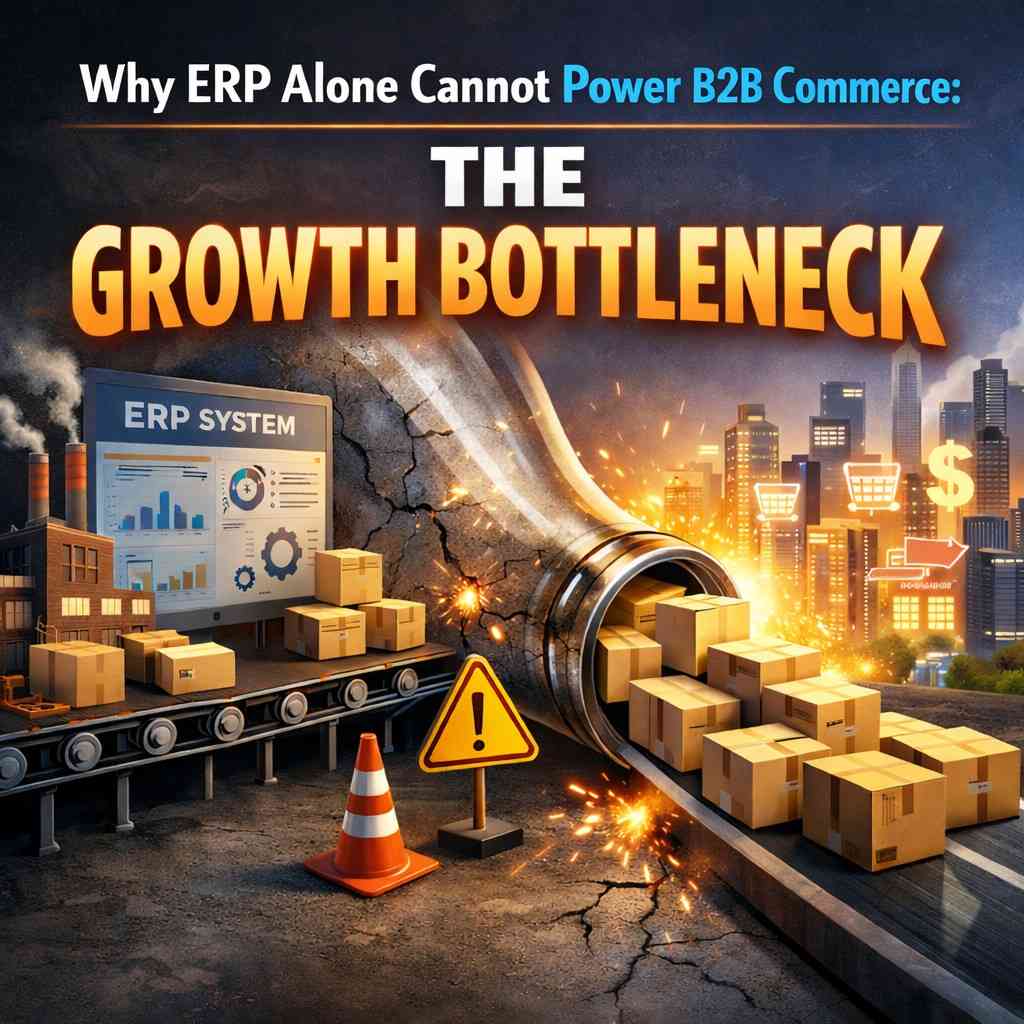
Hidden Costs of B2B eCommerce Platforms Most Businesses Ignore
The true cost of a B2B eCommerce platform extends far beyond implementation. Licensing, integrations, custom development, third-party applications, infrastructure, and operational complexity can significantly increase long-term investment. Understanding these hidden costs is essential for making smarter technology decisions.
Platform Costs
Visible vs Hidden Investment
The Budget Isn't the Real Cost
When businesses begin planning a B2B eCommerce platform, the conversation often starts with implementation cost. However, experienced technology leaders evaluate something much broader—the long-term cost of owning, operating, and scaling the platform.
"How much will it cost to build?"
"What will it cost to own, scale & maintain over the next five years?"
The difference between these two questions is substantial. Many B2B commerce projects remain within their original implementation budget yet exceed their overall Total Cost of Ownership due to expenses that only become visible after launch.
Recurring platform subscriptions, API limitations, integration complexity, technical debt, ongoing support, maintenance, and future replatforming costs can ultimately exceed the original development investment. Understanding these factors before selecting a platform enables organizations to make more informed, long-term technology decisions.
The smartest investment decisions are based on Total Cost of Ownership, not simply the implementation budget.
API Limitations That Slow Business Growth
Modern B2B commerce platforms rarely operate in isolation. They exchange data continuously with ERP systems, CRM platforms, inventory management, warehouse software, accounting applications, shipping providers, and procurement tools.
Although many vendors advertise API support, not every platform offers the same flexibility. API rate limits, premium API access, missing endpoints, vendor restrictions, and limited customization frequently introduce hidden operational costs as transaction volumes increase.
Instead of enabling growth, the platform begins creating operational bottlenecks that require expensive middleware and custom integration work.
API rate limits • Premium API pricing • Missing endpoints • Vendor restrictions • Middleware • Custom integrations
Scaling Costs Nobody Mentions
A platform that comfortably supports hundreds of customers may struggle when supporting tens of thousands. As your business expands, operational costs increase in ways that are rarely included in initial implementation proposals.
Launch
Platform comfortably supports initial operations.
Growth
Infrastructure and integration requirements begin increasing.
Expansion
More users, orders, and data create higher operating costs.
Enterprise
Performance optimization and additional services become essential.
Scale
Total Cost of Ownership becomes more important than implementation cost.
Infrastructure Growth
- Higher hosting requirements
- Cloud infrastructure
- Database optimization
- CDN expansion
Platform Growth
- Software licenses
- Third-party services
- Performance optimization
- Monitoring tools
SaaS Pricing Factors
- Revenue
- Order volume
- API usage
- Users & storage
As your business grows, operational expenses often increase faster than expected. The real measure of affordability is the platform's Total Cost of Ownership (TCO), not its first-year implementation cost.
Technical Debt Becomes Expensive
Technical debt is created when short-term development decisions prioritize speed over long-term maintainability. While these shortcuts can accelerate delivery initially, they often become significant obstacles as the platform evolves.
Today
- Hard-coded business rules
- Duplicate code
- Poor documentation
- Temporary development shortcuts
- Custom integrations without standards
- Outdated plugins
Years Later
- Longer development cycles
- Higher maintenance costs
- Risk of breaking existing functionality
- Slow feature delivery
- Reduced innovation
- Higher Total Cost of Ownership
Technical debt doesn't just increase development costs— it reduces an organization's ability to innovate, adapt, and grow.
Maintenance Is a Continuous Investment
Many organizations assume development ends when the platform launches. In reality, launch is only the beginning. Maintaining a secure, stable, and high-performing B2B eCommerce platform requires ongoing investment throughout its lifecycle.
Security
- Security updates
- Compliance patches
- Backup management
Platform Health
- Platform upgrades
- Bug fixes
- Browser compatibility
Performance
- Performance tuning
- Server monitoring
- Infrastructure optimization
Business Continuity
- Reliable customer experience
- Reduced downtime
- Operational stability
Ignoring maintenance doesn't reduce costs—it simply postpones them. For enterprise B2B environments where customers rely on self-service ordering, maintenance should be treated as an ongoing business investment, not an optional expense.
The Cost of Replatforming
One of the most overlooked expenses in digital commerce is replacing an unsuitable platform. Replatforming involves far more than transferring products—it requires rebuilding the operational foundation that supports your entire business.
Business Data
- Product catalogs
- Customer accounts
- Historical orders
- Pricing rules
Integrations
- ERP connections
- Customer-specific catalogs
- Custom workflows
- API rebuilding
Digital Assets
- SEO preservation
- Redirect strategy
- Content migration
- Search visibility
People & Process
- Team retraining
- User adoption
- Operational testing
- Go-live support
Choosing the Right Platform Early Matters
For many enterprise organizations, replatforming can cost as much as—or even more than—the original implementation. Selecting an architecture that supports long-term business goals helps reduce disruption, minimize future migration costs, and improve Total Cost of Ownership (TCO).
The cheapest platform today can become the most expensive platform to replace tomorrow.
Looking Beyond the Price Tag
When evaluating B2B eCommerce platforms, implementation cost is only one part of the decision. The questions leadership teams ask today often determine the platform's long-term value, flexibility, and Total Cost of Ownership.
The most significant platform costs are often the ones that never appear in the implementation proposal. Evaluating long-term scalability, flexibility, and maintainability is essential for achieving a lower Total Cost of Ownership (TCO).
Hidden Costs Impact ROI
The platform with the lowest implementation cost doesn't always provide the greatest long-term value. Hidden operational expenses often determine whether an investment delivers a strong return over its lifecycle.
Lower upfront investment
Higher upfront investment
Look Beyond the Initial Investment
Implementation cost represents only one part of a technology investment. Businesses should evaluate integration flexibility, scalability, maintenance requirements, customization effort, and long-term operational costs before selecting a platform. These lifecycle factors often have a greater impact on Return on Investment than the original project budget.
Hidden Cost Checklist
Before selecting any B2B eCommerce platform, leadership teams should evaluate more than implementation costs. Use this framework during vendor discussions to identify potential long-term expenses before they become operational challenges.
API Flexibility
Can future integrations be completed without expensive workarounds or premium API access?
Integration Capabilities
Does the platform integrate easily with ERP, CRM, PIM, WMS, and future business systems?
Future Scaling Costs
Will infrastructure, licensing, and operational costs increase as the business grows?
Technical Debt
Will today's implementation decisions create expensive maintenance challenges later?
Maintenance Strategy
Are updates, security patches, monitoring, and platform upgrades planned and budgeted?
Upgrade & Replatforming
How difficult would future upgrades or migration be if business requirements change?
Every "Yes" reduces future risk.The more confidently your team can answer these evaluation questions, the greater your ability to control Total Cost of Ownership, improve long-term scalability, and maximize the business value of your eCommerce investment.
Continue with the Executive Guide
Explore our LinkedIn carousel, "The 6 Hidden Costs of B2B eCommerce Platforms Every Leadership Team Should Evaluate Before Signing a Vendor." It expands on the concepts covered in this article with a practical vendor comparison matrix, procurement checklist, and decision framework designed to support technology evaluations.
Think Beyond Implementation Costs
Successful B2B eCommerce projects are measured by the business value they create over many years—not simply by the cost of launching the platform. Organizations that evaluate long-term ownership before implementation are better positioned for sustainable growth.
Plan Long-Term
Evaluate the complete platform lifecycle instead of focusing only on launch costs.
Reduce Hidden Costs
Identify API limitations, maintenance overhead, and technical debt before implementation.
Design for Scale
Choose an architecture capable of supporting future growth without major rework.
Protect ROI
Lower Total Cost of Ownership creates greater long-term business value.
Future-Proof
Invest in a platform that enables innovation rather than limiting it.
The cheapest platform today can easily become the
most expensive platform tomorrow.
Choose an architecture that delivers long-term scalability, operational efficiency, and sustainable business growth—not simply the lowest implementation cost.

Aravind S., CFO of Ceymox, is a strategic finance leader with a sharp focus on operational excellence, sustainable scaling, and financial innovation within the digital commerce ecosystem. As a key pillar in Ceymox’s leadership, Aravind brings deep expertise in financial planning, risk management, costing, and performance optimization—ensuring the company’s growth remains efficient, stable, and future-ready.With extensive experience in managing financial systems for IT and eCommerce service organizations, Aravind plays a crucial role in transforming business operations into predictable, measurable, and scalable models. His approach blends analytical rigor with business foresight, enabling data-backed decision-making that accelerates growth and improves profitability.Beyond numbers, Aravind is passionate about strengthening financial governance, optimizing resource allocation, and building long-term value for clients, partners, and stakeholders. His strategic insights continue to guide Ceymox as it expands its presence in the global Magento and digital commerce space.
View All Articles