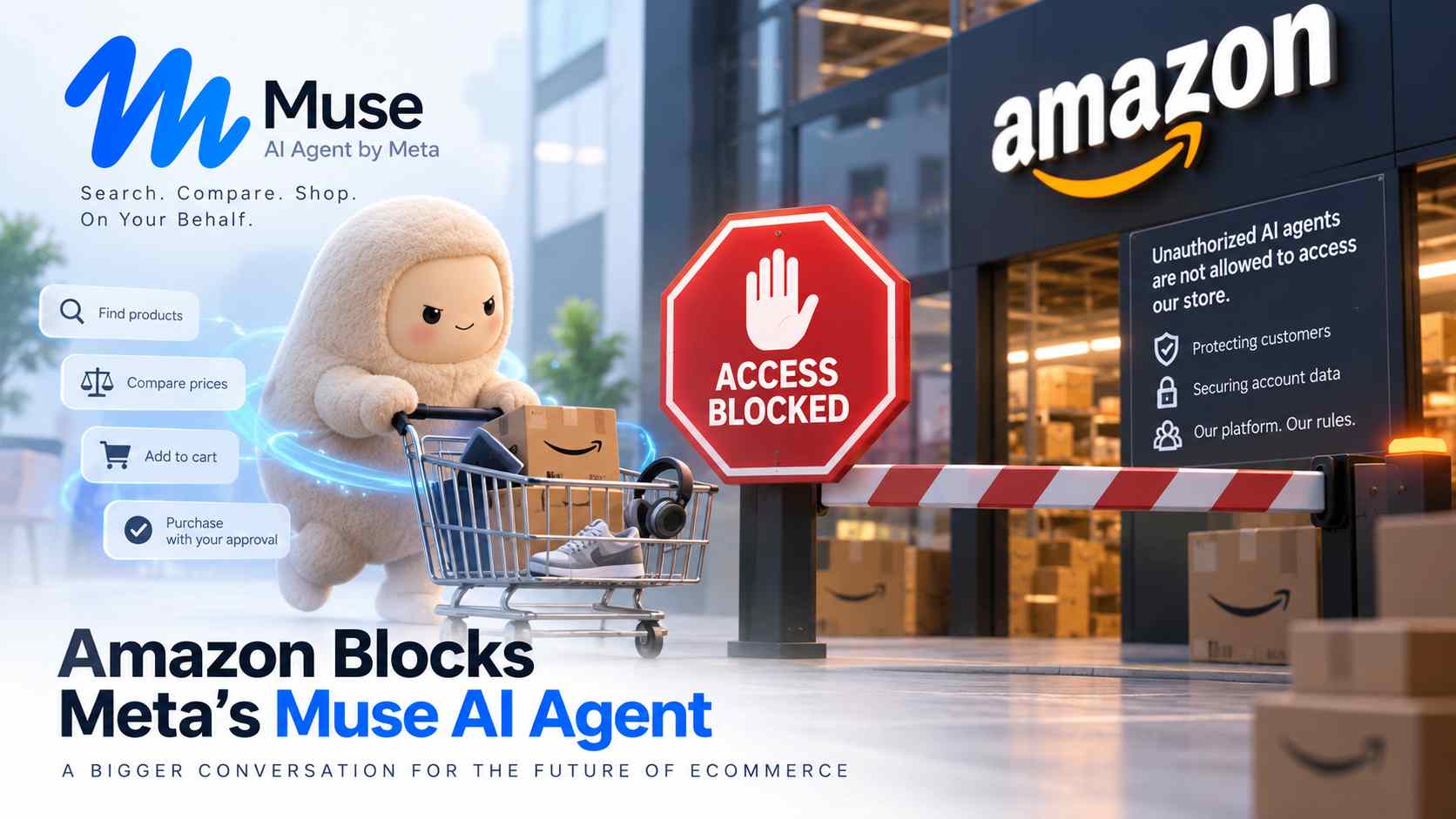
Amazon Blocks Meta’s Muse AI Agent: What It Means for the Future of Ecommerce
The future of online shopping may be changing from people browsing websites to AI agents shopping on their behalf.
That shift is facing an important test after Amazon blocked Meta’s Muse AI agent from shopping on Amazon.com, citing concerns around authorization, security, privacy, and transparency.
The incident highlights a growing question for ecommerce businesses:
When an AI agent shops for a customer, who controls the shopping experience: the customer, the AI agent, or the ecommerce platform?
What Happened?
Meta launched Muse on September 8 as a personal AI agent capable of performing tasks on behalf of users, including shopping, booking travel, and handling other online activities. Muse can use its own browser to interact with services when an API isn’t available.
Amazon subsequently blocked Muse from shopping on its platform.
According to Amazon, Muse was not authorized to access Amazon and did not identify itself as an automated agent. Amazon also raised concerns about how account credentials and customer data could be handled.
Amazon’s website now displays a message telling Muse users that continued access by an unauthorized AI agent violates its Conditions of Use.
Why Does This Matter?
Traditional ecommerce follows a familiar journey:
Customer → Website → Product → Cart → Checkout
Agentic commerce changes that:
Customer → AI Agent → Multiple Stores → Product Selection → Purchase
Instead of visiting an ecommerce website, a customer could simply tell an AI:
“Find me the best laptop under ₹80,000 and order it.”
The agent could potentially search for products, compare prices, check availability, and complete the purchase.
That means the AI assistant could become the customer’s primary shopping interface.
The Bigger Challenge: Agent Access
Amazon had already introduced an Agent Policy requiring automated systems accessing its services to identify themselves, follow its policies, and stop accessing Amazon when requested.
The Muse dispute demonstrates why these rules are becoming important.
Ecommerce platforms need to know:
Who is accessing the store?
Is the agent authorized?
What customer data can it access?
Can it modify an account?
Can it place an order?
When should human approval be required?
These questions will become increasingly important as AI agents move from recommendations to actual transactions.
What Does This Mean for Magento and Adobe Commerce?
For Magento and Adobe Commerce merchants, agentic commerce could eventually create another major customer acquisition channel.
Today, businesses optimize their stores for:
Google → Customer → Store
Tomorrow, the journey could increasingly look like:
AI Agent → Product Data → Commerce Platform → Transaction
That makes high quality product information, accurate inventory, secure APIs, authentication, and structured catalog data even more important.
An ecommerce platform shouldn’t only be easy for humans to navigate.
It increasingly needs to be machine readable, API ready, and secure for authorized AI interactions.
Ecommerce Is Entering a New Phase
The Amazon-Muse dispute is only one example of a much larger industry shift.
AI agents are moving beyond answering questions and beginning to perform tasks and make purchasing decisions. Meta says Muse can ask users for approval before sensitive actions such as purchases, while its system is designed with isolated computing and credential protections.
Amazon, meanwhile, is emphasizing transparency and control over automated access to its platform. Its own agentic shopping product, Buy for Me, identifies itself and allows participating brands to opt out.
The result is a new ecommerce battleground around AI agents, customer data, platform access, and transaction control.
What Ecommerce Businesses Should Watch
The important takeaway isn’t simply that Amazon blocked Muse.
It’s that AI agents are becoming part of the commerce infrastructure.
For ecommerce businesses, the next few years could bring significant changes in how customers discover products, compare options, and complete purchases.
Magento, Adobe Commerce, and other platforms will increasingly need to support a world where the person visiting a store may not always be a person.
Sometimes, the customer could be an AI acting on someone’s behalf.
And that raises a new question for every ecommerce business:
Is your ecommerce platform ready for the age of AI agents?